
PR 01/26 | KTP calls for identity-driven quality design in the establishment of the three proposed national parks
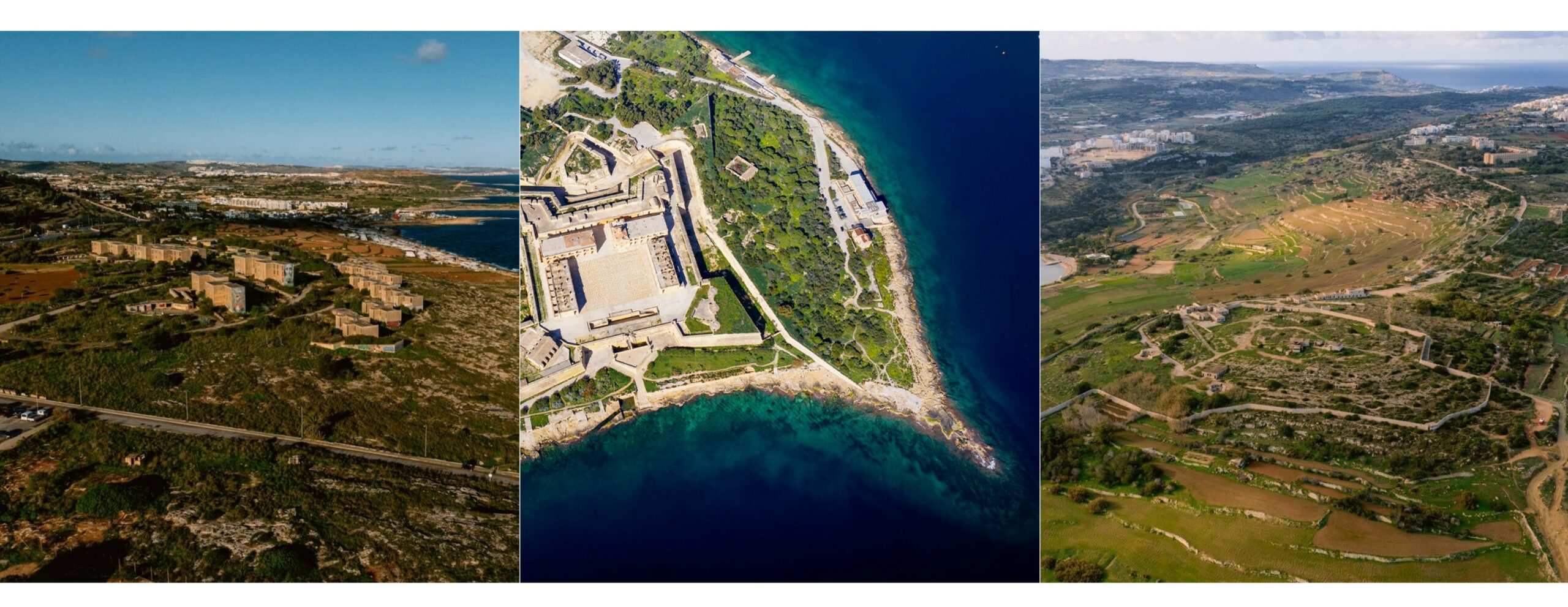
The Government of Malta’s proposal to establish national parks at Manoel Island, White Rocks, and Fort Campbell provides a significant opportunity to make a fundamental shift towards long‑term environmental stewardship, public accessibility, and cultural regeneration. The Kamra tal‑Periti welcomes this direction while emphasising that the success of these flagship projects depends on rigorous planning, strong design leadership, and a clear identity for each site.
In this context, and as a response to the Government’s Shape Your Space consultation through Parksinmalta.mt, the Kamra tal‑Periti is publishing a comprehensive reply Conserving Nature, Promoting Adaptive Reuse: Sustainable Stewardship of Malta’s National Parks. This publication outlines a vision for national parks in Malta and presents a framework to guide the transformation of these three major sites into Malta’s national parks.
The new national parks will only succeed if they are identity‑driven, embedded in a Baukultur principles, and their design procured by competition. The Kamra underscores the importance that the White Rocks, Manoel Island and Fort Campbell develop a unique, context-driven identity, grounded in their history. It is also stresses how across all three sites, existing buildings are to be considered as assets and not obstacles, promoting adaptive reuse. Most importantly, the Kamra calls for open and transparent architecture design competitions, to ensure excellence, transparency and public trust in the procurement of the design services. The organisation of architectural design competition is a guarantee of high-quality design outcomes as it pitches the best design proposals on the basis of merit before an expert jury, as opposed to conventional tenders which award contracts on the basis of cheapest price, which seldom results in the best use of public funds in the long-term.
The Kamra is offering its technical assistance in the organisation and management of architectural design competitions as it has done on a number of occasions with various public entities in the past. Several other key proposals can also be found in its detailed public consultation document.
Executive Summary
The Government of Malta’s proposal to establish National Parks at Manoel Island, White Rocks, and Fort Campbell provides a significant opportunity to make a fundamental shift towards long‑term environmental stewardship, public accessibility, and cultural regeneration. The Kamra tal‑Periti welcomes this direction while emphasising that the success of these flagship projects depends on rigorous planning, strong design leadership, and a clear identity for each site.
Distinct Identity for Each Park
The Kamra strongly recommends that each proposed National Park must develop a unique, context‑driven identity, shaped by its history, landscape, setting, and community relevance. Identity should act as a long‑term design and governance tool, preventing ad‑hoc decisions, avoiding over‑commercialisation, and ensuring spaces remain primarily for public enjoyment rather than revenue‑driven activities. [see section 2]
Regeneration Before Demolition
Existing structures across the three sites should be treated as assets, not constraints. Adaptive reuse provides environmental benefits through reduced embodied carbon, while preserving the cultural narratives embedded in the built fabric. Function must be central to any restoration strategy to ensure long‑term care, daily use, and active stewardship.
Quality‑Led Design Competitions
Given the national significance of the parks, KTP strongly advocates for independent, open design competitions, based on measurable outcomes in sustainability, heritage protection, spatial quality, and Baukultur principles. A two‑stage competition with professional remuneration ensures fairness, ambition, and excellence while reducing future maintenance burdens.
Alignment with Baukultur
The Baukultur framework reinforces a holistic, human‑centred approach to the built environment. For the National Parks, this requires:
- Integrated planning of architecture, landscape, mobility, and heritage
- Inclusive, accessible design for all ages and abilities
- Long‑term stewardship, not short‑term intervention
- Interdisciplinary collaboration and meaningful public engagement
Connectivity & Spatial Strategy
The parks must become part of a wider national green network. Priority should be given to:
- Sustainable transport: walking, cycling, public transport, and in coastal contexts, maritime links
- Restriction of vehicular penetration
- Strong connections with surrounding communities through formal and informal spaces
Site‑Specific Potentials
The following identity proposals are only indicative, simply to show how each National Park can take on a distinct role within a larger network of public spaces, avoiding overlap and encouraging diversity.
White Rocks – A Coastal Cultural & Educational Park
With an extensive shoreline and a varied collection of buildings, White Rocks is well‑suited for a cultural, educational, and research‑oriented identity. The site can become a national hub for environmental awareness, science, outdoor learning, and adaptive reuse. Its coastal setting supports low‑impact recreation and landscape‑driven design.
Manoel Island – An Urban Park
Manoel Island’s location within a dense urban context positions it as an active city park with strong recreational, sporting, and maritime potential. Its identity should emphasise daily use, walkability, and integration with Valletta, Sliema, and Gżira. Existing military and hospital structures offer significant opportunities for adaptive reuse.
Fort Campbell – A Landscape & Heritage Park
Fort Campbell’s remote coastal setting and unique military fabric lend themselves to a landscape‑led, contemplative park rooted in ecology, memory, and heritage conservation. The site requires sensitive intervention, extensive restoration, and careful phasing due to its fragile condition. Its identity should privilege nature, tranquillity, and minimal built intervention